


Adapting Sofa Upholstery for Seniors and Those with Restricted Movement
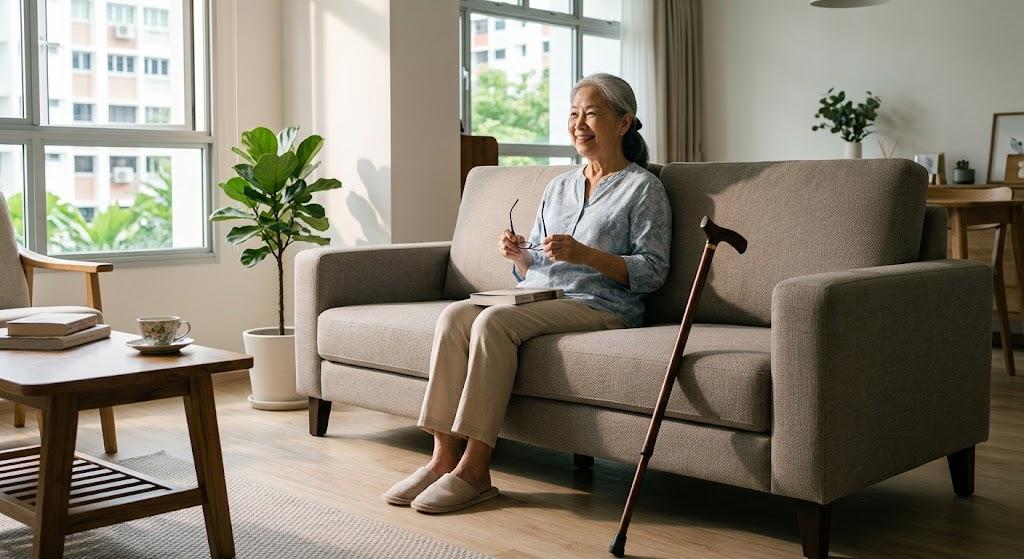
Falls are the leading cause of injury among older adults. Most prevention advice targets kitchens, bathrooms, and staircases. Almost none of it addresses the living room — specifically, the sofa that dominates it.
Consider how many hours a day someone spends sitting. For a person with reduced strength or range of motion, the physical properties of that seat determine whether they remain comfortable and independent or slowly lose both. Every detail matters — from the density of the padding underneath to the weave of the fabric overhead.
The good news is that upholstery choices are highly adjustable. Unlike replacing an entire room's flooring or installing structural hardware, rethinking a sofa's construction is targeted, scalable, and often surprisingly affordable.
Firmness Is Not the Enemy
Marketing has conditioned consumers to equate softness with quality. The sinking feeling of a plush couch reads as indulgent. For younger people with strong muscles and flexible joints, it is. For someone in their seventies or eighties, that same sensation becomes a daily struggle.
The mechanics are straightforward. When foam yields deeply under body weight, the pelvis descends below the seat's front edge. Standing from that position requires the person to generate enough force to lift their full mass out of the depression. Knees absorb that force first. Then wrists, if they are pushing off the armrests. The cumulative toll over weeks and months is considerable.
High-density foam resolves the issue by maintaining the body on the cushion's upper surface. The center of gravity stays forward, and standing becomes a weight transfer rather than a lift. Providers of Singapore sofa upholstery frequently recommend high-resilience formulations for clients over sixty-five. The material costs marginally more but delivers substantially better functional performance over the sofa's lifetime.
Firmness, in this context, is not a compromise on comfort. It is a redesign of comfort to match what the body actually needs.
Surface Friction and How It Shapes Movement
The fabric stretched across the cushion does more than provide visual appeal. It governs how easily the body can slide, grip, or reposition itself during the act of standing.
Rough, heavily textured textiles — chenille, corduroy, velvet — create excessive friction against clothing. The occupant becomes effectively anchored to the seat. Sliding forward to the cushion's edge, a prerequisite for standing, becomes difficult or impossible. They must then push upward from a deep, mechanically disadvantaged position.
Ultra-smooth materials present the inverse problem. Thin vinyl, certain lacquered finishes, and heavily treated synthetics allow uncontrolled slipping. The person slides into a slouched posture gradually, compressing the torso and making each breath require more effort. Over time, this position contributes to fatigue and respiratory strain.
Leather navigates between these extremes effectively. It provides enough give for intentional forward movement while maintaining sufficient surface resistance to prevent accidental shifting. Genuine leather has limitations — it feels cold initially and can cause discomfort in hot climates. For those situations, tightly woven synthetic alternatives replicate the friction profile without the temperature sensitivity. Staff at many firms offering sofa upholstery services can demonstrate side-by-side comparisons of these materials.
Protecting Fragile Skin Through Fabric Selection
The integumentary system undergoes measurable changes during aging. Skin thins, its moisture content drops, and its capacity to repair damage diminishes. Contact with the wrong upholstery material can aggravate these vulnerabilities in ways that become medically significant.
Heavy synthetic fabrics create microenvironments that trap heat and moisture against the body. For a person who remains seated for extended periods, the sustained warmth and perspiration can produce skin irritation, rashes, and in severe cases, early-stage pressure injuries. These outcomes are not theoretical — they appear regularly in clinical assessments of home-care environments.
Breathable natural fibers like cotton and linen mitigate this risk by promoting airflow and absorbing surface moisture. They wrinkle and stain more readily than synthetic options, but the health trade-off favors their use for elderly seating applications.
Microfiber occupies a useful middle ground that many caregivers adopt. It presents a soft, non-abrasive surface against the skin while allowing adequate ventilation. It also resists staining better than most untreated natural fabrics. For environments where spills or incontinence are anticipated, performance textiles with moisture-repellent coatings provide an additional layer of practical protection.
Cleaning, Odor Control, and the Barrier Question
A sofa in a caregiving setting endures punishment that casual household furniture never faces. Daily spills, incontinence incidents, and accumulated biological residue demand a cleaning regimen that would destroy most residential upholstery within months.
Removable, machine-washable cushion covers are therefore non-negotiable. The fabrics selected for these covers must tolerate frequent laundering without shrinking, pilling, or losing color. Equally important are the zipper mechanisms — heavy-gauge zippers survive repeated opening and closing, while lightweight alternatives break quickly.
Odor-resistant fabric treatments provide a surface-level benefit. But the real concern hides beneath the cushions. Any liquid that reaches the foam core becomes a permanent resident of that material. Foam absorbs and retains organic odors in ways that no detergent can fully reverse. Once contaminated, it must be replaced entirely.
A concealed waterproof membrane between the outer fabric and the foam prevents this outcome. Specialists in Singapore sofa upholstery incorporate these barriers regularly for clients managing incontinence or high spill risk. The installation adds negligible bulk and no visible change to the sofa's appearance, yet it protects the most damage-prone component of the entire structure.
Geometric Considerations: Height and Depth
Two measurements govern whether a person can use a sofa independently. Seat height — measured from the floor to the sitting surface — determines how much effort standing requires. Seat depth — measured from the front edge to the backrest — determines whether the occupant's body is positioned correctly for that effort.
An excessively deep seat pushes the person's knees past the cushion edge. The lower legs hang without support. Blood pools in the feet. Swelling increases. More critically, the person cannot plant their feet firmly on the ground, removing the stable base needed to push upward.
A seat that sits too low reverses the geometry unfavorably. The knees rise above the hips, and the muscular force required to achieve a standing position exceeds what most aging bodies can produce.
The generally accepted dimensions for senior-friendly seating place seat height between 18 and 19 inches and seat depth at a length that allows full backrest contact with feet flat on the floor. When the existing frame doesn't comply with these targets, structural correction is straightforward.
This is precisely the type of work that experienced sofa upholstery services handle routinely. Technicians can insert firm lumbar bolsters to reduce effective depth or replace base cushioning with thicker material to raise the sitting surface.
Armrest Engineering and Backrest Posture
People rarely examine armrests critically. But for anyone with compromised lower-body strength, armrests function as essential mechanical aids. They are the surfaces against which the hands generate the force that propels the body upward.
If the armrest consists only of foam padding over a wooden frame, downward pressure causes the hand to sink through the material. The person receives no leverage. The push-off fails. They may need to attempt the motion multiple times or call for assistance.
Armrests must feel rigid under load. This can be achieved through tightly wrapped compressed foam, built-up layers of firm padding, or direct mounting of a hard surface beneath the outer fabric. The covering itself should provide tactile grip — a smooth or polished armrest surface introduces slip risk at the worst possible moment.
The backrest angle deserves equal scrutiny. A sofa designed for casual lounging typically tilts backward significantly. This angle works against anyone trying to stand, because the body must first overcome the backward lean before the weight can shift forward. An upright backrest eliminates this counterproductive geometry and supports a more natural sitting posture.
The Safety Implications of Color Choice
A detail that escapes most furniture conversations is the role of visual contrast in preventing falls. People with age-related vision decline — whether from cataracts, glaucoma, or general deterioration — depend on visual cues to navigate their surroundings.
Dark upholstery colors absorb light and blend into dimly lit floors. The boundary between the sofa and the floor becomes indistinct. A person with poor vision approaching the couch may not recognize where the seat begins, leading to misjudged positioning and potential falls.
Medium-toned fabrics — particularly those with visible texture or patterning — create the visual separation needed for safe navigation. The occupant can identify the seat's boundaries from a distance and align their body before sitting.
Many consultants working within Singapore sofa upholstery prioritize medium-saturation options when advising families on elderly-friendly furniture. They recognize that this seemingly aesthetic decision carries measurable safety implications for users with declining visual acuity.
When Expert Intervention Becomes Essential
Throw pillows, slipcovers, and surface modifications cannot compensate for fundamental structural deficiencies. When the foam is wrong, the height is incorrect, or the frame geometry works against the occupant, professional expertise is the only reliable remedy.
This falls squarely within the domain of qualified sofa upholstery services. A trained technician approaches the problem methodically — assessing the existing structure, identifying which elements need alteration, and executing changes that address the individual's specific physical requirements.
Local practitioners experienced with Singapore sofa upholstery bring additional value through their familiarity with regional material challenges. Tropical humidity accelerates foam degradation and encourages microbial growth within cushion interiors. Selecting professionals who work within that climate ensures appropriate material choices and construction methods that will endure.
Professional modification also preserves frames that are otherwise structurally sound. Rather than discarding a well-built sofa due to cushioning or dimensional problems, expert work targets only the elements that have failed the user.
Closing Observations
Every component of a sofa contributes to whether an older person can use it safely and with dignity. Foam density determines how much effort standing requires. Surface texture governs whether the body can position itself for that effort. Dimensions establish the geometric foundation. Armrests provide the leverage. Color ensures the seat is visible.
When these elements work in harmony, the result extends beyond physical safety. The person regains the ability to sit and rise independently — a capacity that directly influences psychological well-being and self-perception.
If the current sofa fails in any of these areas, professional assessment may reveal that targeted modifications can resolve the problem without full replacement. The investment in thoughtful upholstery adjustment pays dividends not just in comfort, but in the independence it preserves.

 English
 Arabic
 French
 Spanish
 Portuguese
 Deutsch
 Turkish
 Dutch
Dutch
 Italiano
 Russian
 Portuguese (Brazil)
 Greek
Greek
