


How Does a Wi-Fi Thermostat Work? A Practical Guide to Smarter Home Comfort
If you have ever adjusted your home's temperature from your phone, you may have wondered: How does a Wi-Fi thermostat work?
At its core, a Wi-Fi thermostat controls heating and cooling equipment much like a traditional thermostat. The major difference is connectivity. By connecting the thermostat to your home Wi-Fi network, you can check temperatures, change settings, create schedules, and monitor your HVAC system remotely.
But Wi-Fi is only one part of the system. Behind the touchscreen and mobile app, the thermostat still needs to communicate correctly with your furnace, air conditioner, or heat pump. Understanding that relationship makes it much easier to decide whether upgrading makes sense.
What Is a Wi-Fi Thermostat?
A Wi-Fi thermostat is an HVAC controller with built-in wireless connectivity.
It measures indoor temperature and compares it with the temperature you have selected. When heating or cooling is needed, the thermostat sends a low-voltage control signal to the appropriate HVAC equipment.
Wi-Fi adds another communication layer. Instead of changing the temperature only from the wall, homeowners can typically use a smartphone app to:
- Adjust heating and cooling remotely
- Change schedules
- Switch operating modes
- Check indoor temperature
- Receive HVAC alerts
- Review energy or runtime information
A modern wifi HVAC thermostat therefore combines traditional HVAC control with connected software and remote management.
How Does a Wi-Fi Thermostat Actually Control HVAC Equipment?
Most central HVAC systems used in North American homes rely on low-voltage thermostat wiring, commonly 24VAC.
Different wires and terminals perform different jobs. Common examples include:
- R – 24VAC power
- C – common connection
- Y/Y2 – compressor or cooling stages
- W/W2 – heating stages
- G – indoor fan
- O/B – heat pump reversing valve
Suppose you set your thermostat to 72°F while the indoor temperature is 76°F. If the system is in cooling mode, the thermostat can call for the compressor and fan to operate.
Once the room approaches the target temperature, the thermostat ends that call.
The basic principle is surprisingly similar to a conventional thermostat. What makes today's models smarter is everything that happens around this basic control process.
What Does Wi-Fi Add?
Connecting a thermostat to the internet does not change the fundamental way the furnace or heat pump produces heating and cooling. Instead, it changes how you interact with the HVAC system.
For example, imagine leaving home and realizing that you forgot to change the thermostat. With a connected thermostat, you can make the adjustment remotely rather than heating or cooling an empty house all day.
Wi-Fi connectivity can also support scheduling, energy reports, weather information, software updates, maintenance notifications, and integration with compatible smart home platforms.
The exact capabilities vary considerably between products, so buyers should compare actual features rather than assuming every Wi-Fi thermostat works the same way.
How Can a Wi-Fi Thermostat Improve Comfort?
Convenience is an obvious advantage, but comfort can be just as important.
A thermostat normally measures temperature wherever it is mounted. Unfortunately, a hallway temperature may be quite different from a bedroom upstairs or a living room exposed to afternoon sunlight.
Some newer thermostats address this problem through wireless remote room sensors.
Instead of depending entirely on one measurement point, the thermostat can use temperature information from other rooms. Depending on the system, homeowners may be able to prioritize a bedroom at night and a living area during the day.
This can help reduce the familiar problem of one room feeling comfortable while another feels too hot or too cold.
Can a Wi-Fi Thermostat Save Energy?
Potentially, yes—but simply connecting a thermostat to Wi-Fi does not automatically reduce an energy bill.
The savings come from how its features are used.
Useful strategies can include:
- Reducing heating or cooling while the home is empty
- Creating schedules around normal routines
- Avoiding unnecessary HVAC operation
- Using room sensors more effectively
- Reviewing energy or runtime reports
- Adjusting settings remotely when plans change
The HVAC system, climate, insulation, household behavior, thermostat settings, and existing equipment all influence the actual result.
For that reason, claims that every smart thermostat will deliver the same percentage of savings should be treated cautiously.
Do I Need a Wi-Fi Thermostat?
Not everyone does.
If you are comfortable with a simple thermostat and rarely change your schedule, basic programmable control may be enough.
A Wi-Fi thermostat becomes more useful when you want:
- Remote control while away from home
- More flexible scheduling
- Better visibility into HVAC operation
- Remote room sensors
- Smart home integration
- Maintenance notifications
- Control of more advanced HVAC equipment
It can also be particularly useful for vacation properties, rental homes, larger houses, or households with changing schedules.
What About Heat Pumps and Multi-Stage HVAC Systems?
This is where compatibility becomes especially important.
A basic thermostat may be suitable for a straightforward furnace and air-conditioning system, but heat pumps can require additional controls for the reversing valve, auxiliary heat, emergency heat, and multiple compressor stages.
Dual-fuel systems can be more complicated again because the thermostat may need to coordinate a heat pump with a gas or propane furnace.
Before purchasing any thermostat, check the HVAC equipment type and the number of heating and cooling stages it requires.
Does a Wi-Fi Thermostat Need a C-Wire?
Many Wi-Fi thermostats require continuous power because their displays, processors, wireless radios, and other electronics consume electricity even when the HVAC equipment is not actively heating or cooling.
The C-wire, or common wire, provides a return path for the 24VAC power supply.
Some older homes do not have an available C-wire at the thermostat location. Depending on the thermostat and HVAC system, possible solutions may include installing an additional wire or using a compatible C-wire adapter.
Never assume that two thermostat installations are identical simply because the old thermostats look similar.
What Should You Check Before Buying?
Start with compatibility rather than appearance.
Check:
- Whether your system is conventional or heat pump.
- How many heating and cooling stages it uses.
- Whether auxiliary or emergency heat is required.
- Whether you have a C-wire.
- Whether remote sensors are important.
- Which mobile or smart home ecosystem you use.
- Whether energy reporting or advanced scheduling matters to you.
For more complex HVAC systems, professional installation or at least verification by an HVAC technician can prevent wiring and configuration problems.
How Are Modern Wi-Fi Thermostats Designed?
Behind the consumer-facing app is a combination of HVAC control hardware, embedded software, wireless communication, cloud services, and mechanical design.
For HVAC brands, distributors, property technology companies, and system integrators, this also means selecting an experienced wifi thermostat manufacturer can involve more than comparing the appearance of finished thermostats. HVAC compatibility, firmware, wireless performance, sensor options, API capabilities, quality control, and OEM/ODM support can all matter.
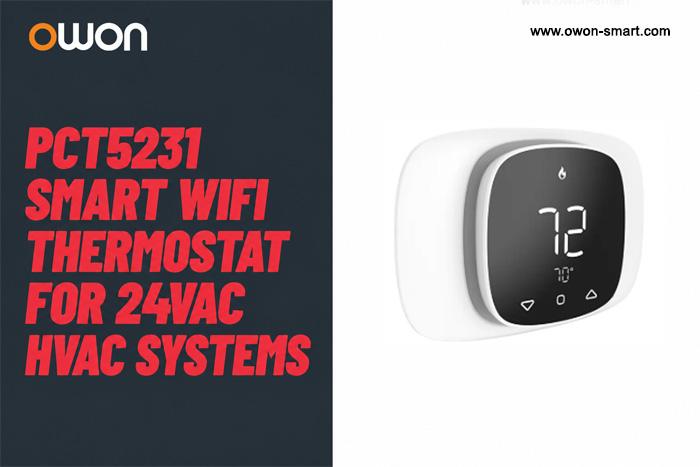
For example, OWON develops Wi-Fi thermostats for North American 24VAC HVAC applications. The PCT5231 is one example designed to support conventional systems and multi-stage heat pumps, including auxiliary heat, emergency heat, and dual-fuel configurations. It can also work with multiple wireless room sensors and provides scheduling, remote control, and energy usage information.
This illustrates how modern thermostat design is increasingly combining traditional HVAC control with connected-home technology rather than treating them as separate systems.
Final Thoughts
So, how does a Wi-Fi thermostat work? At the HVAC level, it still measures temperature and sends control signals to heating and cooling equipment. Wi-Fi adds the connected layer that makes remote access, flexible scheduling, monitoring, alerts, and smart home integration possible.
For homeowners, the most important question is not simply whether a thermostat has Wi-Fi. The better question is whether the thermostat is compatible with the HVAC system and provides features that solve real comfort or energy-management needs.
Choosing on that basis can make a Wi-Fi thermostat a genuinely useful HVAC upgrade rather than simply another connected device on the wall.

 Arabic
 French
 Spanish
 Portuguese
 Deutsch
 Turkish
 Dutch
Dutch
 Italiano
 Russian
 Romaian
 Portuguese (Brazil)
 Greek
Greek
