


Why Is Cooling System Critical in Bumper Molding?
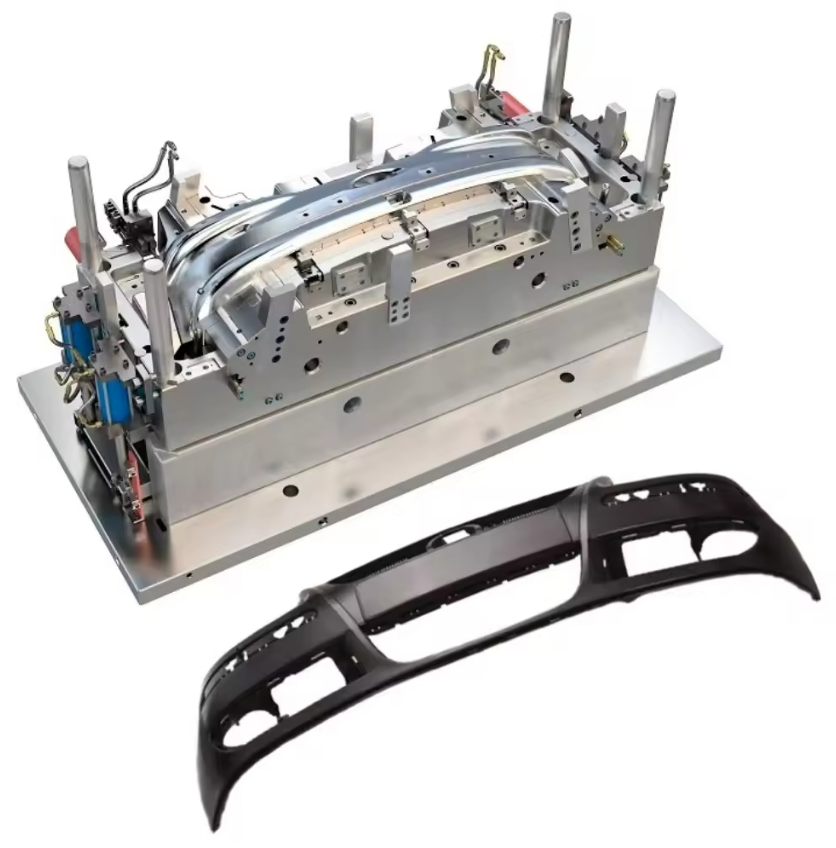
The design of automotive bumper molds is a highly technical process involving structural engineering, thermal management, and flow simulation. A Front Bumper Molding Manufacturer must integrate all these factors to ensure stable mass production and consistent dimensional accuracy.
Mold Structure and Steel Selection
Bumper molds are typically large-scale tooling systems weighing several tons. Common steel materials include:
P20 for core structures (hardness around HRC 28–32)
H13 for high-wear cavity zones (HRC 44–48 after heat treatment)
These steels provide thermal resistance and durability under repeated injection cycles exceeding hundreds of thousands of shots.
Cavity Layout and Multi-Gate Systems
Due to the large size of bumper components, multi-gate hot runner systems are widely used. Gate design must ensure:
Balanced flow distribution across 1000–1600 mm cavity length
Controlled weld line positioning away from visible surfaces
Stable melt pressure across all flow channels
Gate diameter typically ranges from 3.5 mm to 6.0 mm depending on material viscosity.
A Front Bumper Molding Manufacturer uses simulation tools to optimize gate placement before machining begins.
Cooling System Engineering
Cooling design is one of the most critical aspects of mold performance. Uneven cooling can result in warpage and shrinkage variation.
Standard cooling parameters include:
Channel diameter: 8–14 mm
Distance to cavity surface: 10–18 mm
Water temperature: 12°C–25°C
Flow rate: adjusted per zone geometry
Conformal cooling channels are sometimes used in complex bumper molds to improve heat distribution efficiency.
Ejection System Design
Because bumper parts are large and flexible, ejection must be carefully controlled to avoid deformation. Common systems include:
Hydraulic ejector pins
Air-assisted release systems
Side core pull mechanisms for undercut areas
Ejection force must be evenly distributed to prevent stress marks or cracking.
Mold Flow Simulation and Optimization
CAE analysis is widely used to predict:
Filling pattern
Pressure distribution
Air trap locations
Cooling efficiency
Shrinkage behavior
Simulation helps reduce trial-and-error iterations and shortens mold development cycles.
A Front Bumper Molding Manufacturer relies on these predictive models to refine tooling design before production.
Conclusion
Bumper mold engineering integrates structural design, thermal control, and flow analysis into a unified system. A well-developed Front Bumper Molding Manufacturer ensures precision tooling performance, stable production cycles, and consistent part quality across automotive programs.

 English
 Arabic
 French
 Spanish
 Portuguese
 Deutsch
 Turkish
 Dutch
Dutch
 Italiano
 Russian
 Portuguese (Brazil)
 Greek
Greek
