


Beyond Porn: How BlockP Helps Reduce Social Media and Doomscrolling Habits
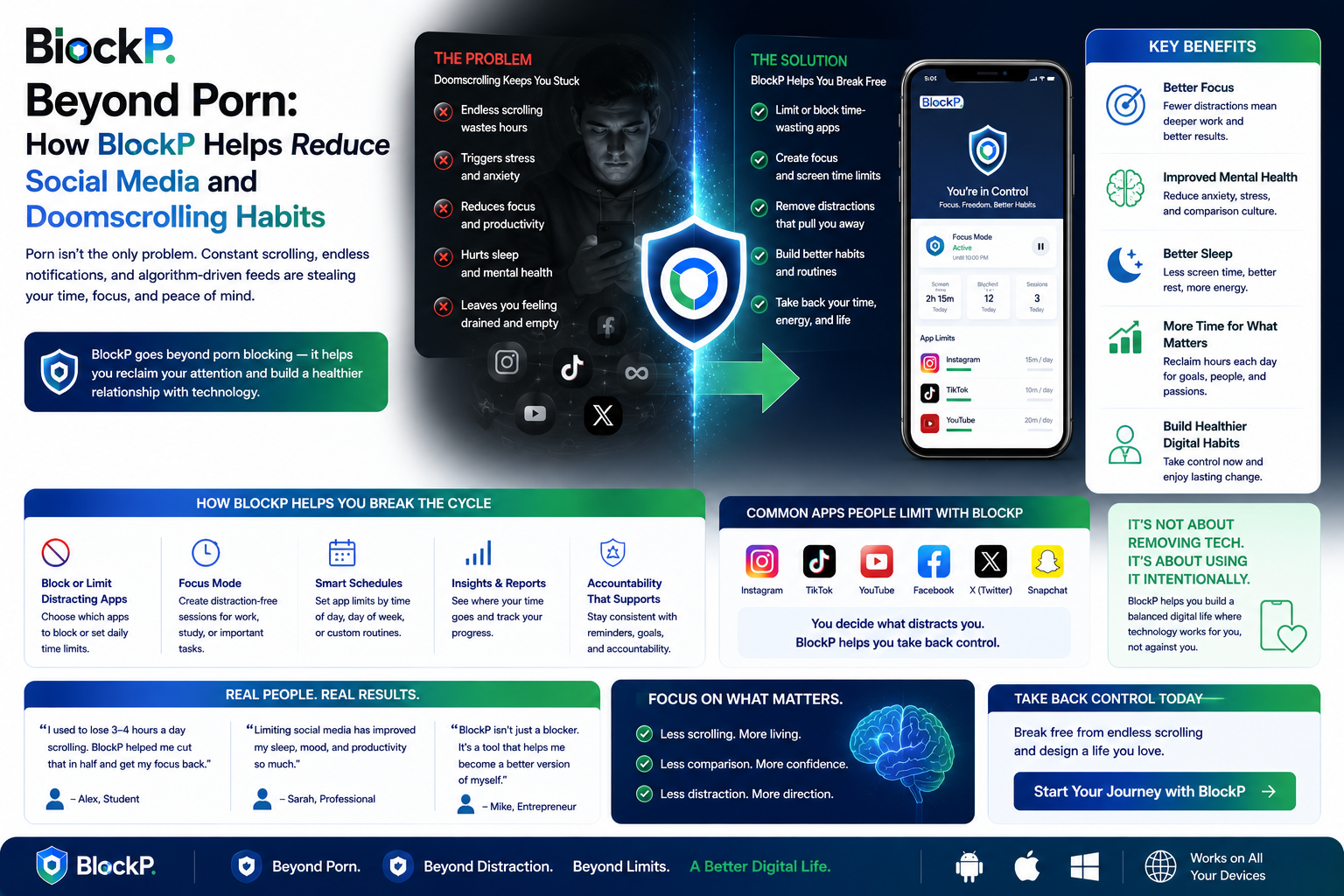
When people think about content blockers, they often associate them with blocking adult content. While that remains an important use case, today's digital challenges extend far beyond a single category of websites. Many individuals struggle with endless social media scrolling, short-form video consumption, and online distractions that quietly consume hours of their day.
A quick visit to Instagram, YouTube, or another social platform can easily turn into an extended browsing session. What starts as a five-minute break often becomes thirty minutes or more of scrolling through content with little intention or purpose.
As awareness of digital wellbeing continues to grow, more people are looking for tools that help them create healthier relationships with technology. This is one reason users increasingly turn to BlockP not only for content filtering but also for managing distractions that affect productivity, focus, and overall digital wellbeing.
Understanding the Rise of Doomscrolling
Doomscrolling refers to the habit of continuously consuming online content, often without a clear goal or stopping point.
While the term originally became popular during periods of intense news consumption, it now applies more broadly to endless scrolling behaviors across social media platforms, video feeds, and recommendation-driven content.
Common examples include:
- Scrolling Instagram for long periods
- Watching YouTube Shorts continuously
- Repeatedly refreshing social feeds
- Jumping from one recommended video to another
- Browsing content long after the original purpose is forgotten
Many users don't intentionally choose to spend excessive time online. Instead, platform design often encourages prolonged engagement.
Why Social Media Feels Hard to Put Down
Modern social media platforms are highly sophisticated.
Features such as:
- Infinite scrolling
- Personalized recommendations
- Auto-playing videos
- Real-time notifications
- Endless content feeds
are designed to keep users engaged.
Each swipe introduces something new.
Each recommendation offers another potential source of entertainment, information, or social interaction.
Because the next piece of content is unpredictable, users often continue scrolling in anticipation of discovering something interesting.
This creates an experience that can feel difficult to interrupt.
The Productivity Cost of Constant Scrolling
Many people underestimate how much attention fragmentation affects productivity.
A short social media break may seem harmless, but frequent interruptions can have cumulative effects.
Some common consequences include:
Reduced Focus
Switching repeatedly between tasks and social content can make it harder to maintain concentration.
Delayed Work Completion
Small distractions often add up over the course of a day.
Mental Fatigue
Constant information consumption can contribute to cognitive overload.
Reduced Intentionality
Many users find themselves consuming content automatically rather than consciously choosing how to spend their time.
These effects can impact students, professionals, entrepreneurs, and anyone pursuing meaningful goals.
Instagram Reels and YouTube Shorts: A New Attention Challenge
Short-form video platforms have become some of the most engaging digital experiences available today.
Instagram Reels, YouTube Shorts, and similar features provide:
- Instant entertainment
- Continuous novelty
- Personalized recommendations
- Minimal effort consumption
Users can watch dozens or even hundreds of videos within a single session.
Because each video is brief, time often feels compressed.
A user may believe only a few minutes have passed when significantly more time has actually elapsed.
This makes short-form content particularly challenging for individuals trying to improve focus and productivity.
Why Blocking Specific Distractions Can Help
One common misconception is that digital wellbeing requires completely abandoning social media.
For many people, that isn't realistic.
Social platforms serve important purposes such as:
- Communication
- Networking
- Education
- Business promotion
- Community engagement
The challenge is often not the existence of these platforms but specific features that encourage excessive use.
This is where targeted blocking becomes valuable.
Instead of eliminating useful tools entirely, users can focus on reducing access to the most distracting elements.
Building Healthier Digital Boundaries
Behavioral research consistently suggests that environment influences behavior.
When distractions are immediately accessible, resisting them requires constant effort.
When distractions are less accessible, productive behaviors often become easier.
Healthy digital boundaries might include:
- Limiting access to specific websites
- Blocking distracting content categories
- Restricting short-form video platforms
- Creating focused work periods
- Reducing exposure to recommendation-driven feeds
The goal is not punishment or restriction.
The goal is intentional technology use.
How BlockP Supports Productivity and Focus
Many users discover that distraction management requires more than motivation alone.
Creating supportive digital environments often makes a significant difference.
With BlockP, users can reduce access to distracting websites, social media platforms, and time-consuming content categories that interfere with personal goals.
For students, this may mean fewer interruptions during study sessions.
For professionals, it can support deeper focus during work hours.
For individuals pursuing personal development goals, it may help create more intentional technology habits.
The result is often not less internet use overall, but more purposeful internet use.
Digital Wellbeing Is About Choice
One important aspect of digital wellbeing is recognizing that technology itself is not the enemy.
Social media platforms offer many benefits.
Online communities provide valuable connections.
Videos can educate, inspire, and entertain.
The objective is not necessarily to eliminate these experiences.
Instead, digital wellbeing focuses on ensuring that technology serves personal goals rather than controlling attention automatically.
This shift from reactive behavior to intentional decision-making is often where meaningful progress begins.
Small Changes Can Produce Meaningful Results
Many people assume major life changes require dramatic actions.
In reality, sustainable improvements often begin with small adjustments.
Examples include:
- Reducing daily scrolling time
- Creating device-free work sessions
- Blocking specific distractions
- Setting clearer digital boundaries
- Prioritizing purposeful online activities
Over time, these small changes can accumulate into healthier habits and improved productivity.
Conclusion
Social media, short-form videos, and endless online content have transformed how people spend their time online. While these platforms provide entertainment and connection, they can also contribute to distraction, reduced focus, and unintentional screen use.
Building healthier digital habits does not require abandoning technology. Instead, it often involves creating boundaries that support personal goals and intentional behavior.
Tools like BlockP help users move beyond basic content filtering by addressing broader digital wellbeing challenges such as doomscrolling, social media overuse, and productivity loss. By creating a more focused online environment, users can spend less time reacting to distractions and more time engaging with what truly matters.
Frequently Asked Questions
Why do short-form videos feel so addictive?
Short-form videos deliver constant novelty, quick rewards, and personalized recommendations. Because each video requires very little effort to consume, users can easily continue watching without noticing how much time has passed.
Can blocking specific features (like Reels) work better than blocking the whole app?
For many users, yes. Some people rely on social media for communication, business, or learning but find certain features particularly distracting. Blocking specific elements may help preserve useful functionality while reducing excessive engagement.
How do I know if my screen time is unhealthy?
Screen time becomes concerning when it consistently interferes with important responsibilities, sleep, productivity, relationships, or personal goals. The total number of hours is less important than whether technology use aligns with how you genuinely want to spend your time.

 English
 Arabic
 French
 Spanish
 Portuguese
 Deutsch
 Dutch
Dutch
 Italiano
 Russian
 Romaian
 Portuguese (Brazil)
 Greek
Greek
