


SoftPOS vs Traditional POS Machine: Which One Saves You More Money?
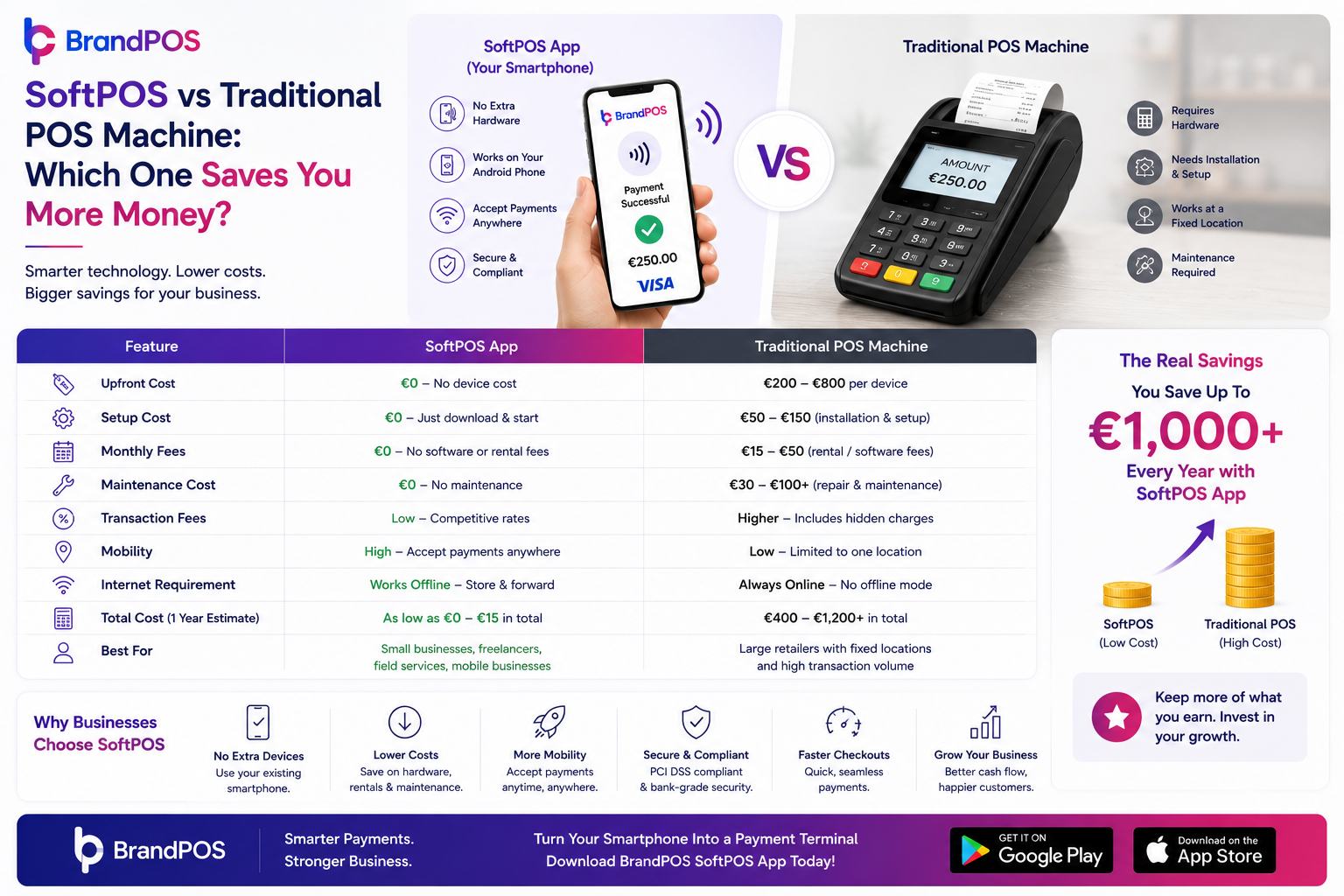
SoftPOS is generally more cost-effective than traditional POS machines because it eliminates hardware costs, reduces setup time, and offers greater flexibility. For most small and growing businesses, it delivers faster ROI with lower upfront investment.
Understanding the Core Difference
If you’re a merchant evaluating payment solutions, the choice often comes down to one question: should you invest in a traditional POS machine or switch to a smartphone-based solution?
That’s where SoftPOS changes the equation.
A traditional POS machine is a physical device that reads cards, requires installation, and often involves rental or purchase costs. On the other hand, a SoftPOS solution transforms your existing smartphone into a payment terminal using NFC technology. No additional hardware. No waiting for delivery or setup.
This fundamental difference directly impacts your costs, flexibility, and how quickly you can start accepting payments.
Traditional machines still have their place, especially in large retail setups. But for small businesses, freelancers, and mobile merchants, the shift toward app-based solutions is becoming hard to ignore.
Cost Breakdown: Where Do You Actually Save?
Let’s talk numbers, because that’s where the real decision happens.
A traditional POS machine typically comes with upfront hardware costs or monthly rental fees. You may also pay for maintenance, servicing, and sometimes even paper rolls for receipts. Over time, these small expenses add up.
In contrast, a SoftPOS app removes most of these costs. Since you’re using your existing smartphone, there’s no need to invest in additional devices. Setup is usually free or minimal, and you only pay a transaction fee when you actually use the service.
Here’s a simple comparison to make things clearer:
| Feature | SoftPOS | Traditional POS Machine |
|---|---|---|
| Hardware Cost | None (uses smartphone) | ₹5,000–₹15,000 or monthly rental |
| Setup Time | Same day | 2–7 days |
| Mobility | Fully mobile | Limited (fixed location) |
| Maintenance | Minimal | Regular servicing needed |
| Receipts | Digital | Paper-based |
When you look at this table, the cost advantage becomes obvious. SoftPOS reduces both upfront and ongoing expenses, which is crucial for businesses operating on tight margins.
Setup, Speed, and Daily Convenience
Beyond cost, there’s another factor that often gets overlooked: time.
Setting up a traditional POS machine isn’t always instant. There’s paperwork, verification, delivery, and installation. For a business that wants to start accepting payments immediately, this delay can be frustrating.
With SoftPOS, the process is much quicker. You download the app, complete your KYC, link your bank account, and you’re ready to go. In many cases, merchants can start accepting payments within hours.
Daily operations are also smoother. You don’t have to worry about carrying an extra device, charging multiple gadgets, or dealing with technical faults in hardware. Everything runs through your phone, which you’re already using.
For businesses that operate on the move—like delivery services, home repair professionals, or event vendors—this flexibility isn’t just convenient, it’s essential.
Security and Trust: Is Cheaper Still Safe?
It’s fair to question whether a lower-cost solution compromises on security. In the case of SoftPOS, that concern doesn’t hold up.
Modern SoftPOS solutions follow strict PCI compliance standards, the same global framework used by traditional payment systems. This ensures that card data is handled securely and never exposed.
Transactions are protected using advanced encryption, which means the data is secured from the moment the customer taps their card or phone. No sensitive information is stored on the device, reducing the risk of breaches.
Traditional POS machines are also secure, but they rely on physical hardware that can sometimes be tampered with or require maintenance. SoftPOS removes this layer of risk by shifting security to certified digital infrastructure.
For customers, the experience also feels safer. They don’t have to hand over their card, which adds a layer of trust during the transaction.
ROI: Which Option Pays Off Faster?
Return on investment is where the difference becomes even clearer.
With traditional POS machines, it can take months to recover the initial cost of hardware and setup. If your transaction volume is low or seasonal, this can stretch even longer.
SoftPOS, on the other hand, starts delivering value almost immediately. Since there’s little to no upfront investment, every transaction contributes directly to your revenue without the burden of recovering hardware costs.
For small merchants, this means less financial risk. You’re not locked into a device or long-term expense. If your business grows, you can scale easily by adding more smartphones instead of buying more machines.
Even for mid-sized businesses, the ability to deploy multiple payment points without additional hardware investment can significantly improve efficiency and customer experience.
So, Which One Should You Choose?
The answer depends on how your business operates.
If you run a large retail store with high transaction volume and a fixed checkout counter, a traditional POS machine might still fit your setup. It’s stable and familiar.
But if you’re looking for flexibility, lower costs, and faster setup, SoftPOS clearly has the edge. It’s especially useful for small businesses, mobile merchants, and anyone who wants to accept payments without being tied to a physical device.
In 2026, the trend is clear. Businesses are moving toward simpler, more agile solutions. And SoftPOS fits perfectly into that shift.
FAQs
1. Which option has a better long-term ROI: SoftPOS or traditional POS?
SoftPOS typically offers faster ROI because there’s no upfront hardware investment. Traditional POS machines take longer to recover costs due to purchase or rental fees.
2. Are transaction charges different between SoftPOS and POS machines?
In most cases, transaction fees are similar since they depend on payment networks and banks, not the device itself.
3. Do I need to upgrade my phone to use SoftPOS?
Only if your current device doesn’t support NFC. Most modern Android smartphones already have this feature built in.
4. What hidden costs should I expect with traditional POS machines?
You may encounter maintenance fees, paper roll costs, servicing charges, and sometimes inactivity fees.
5. Can SoftPOS handle high transaction volumes like retail stores?
Yes, but it depends on your business model. While SoftPOS can scale, high-volume stores may prefer a hybrid setup for operational efficiency.

 English
 Arabic
 French
 Spanish
 Portuguese
 Turkish
 Dutch
Dutch
 Italiano
 Russian
 Romaian
 Portuguese (Brazil)
 Greek
Greek
