


Crowd Behavior Monitoring Enhances Foot Traffic Analysis
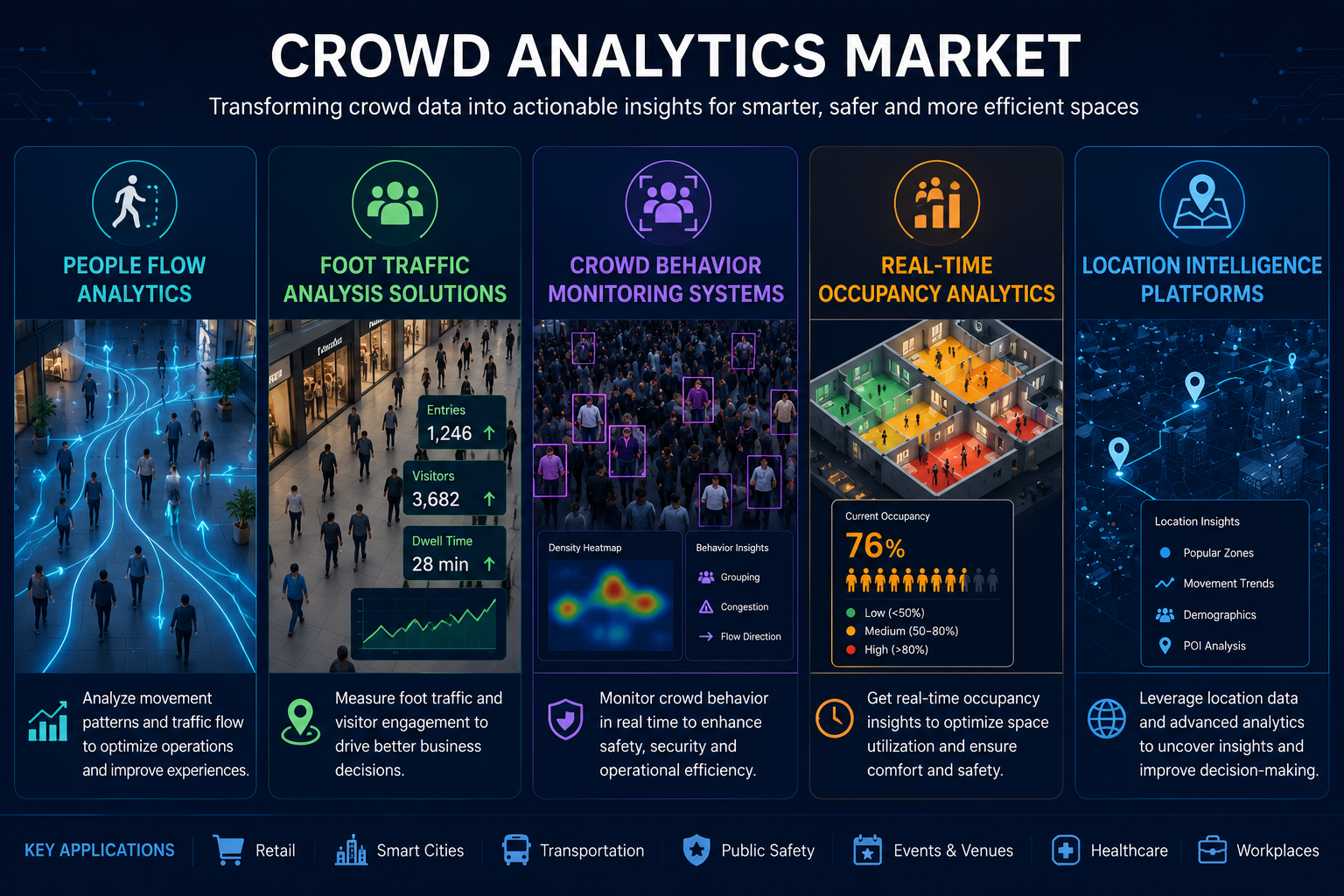
Most foot traffic analysis focuses on normal operations: understanding typical movement patterns to optimize layouts and staffing. But abnormal conditions present the greatest risks. According to a recent study from Market Research Future (MRFR), Crowd Behavior Monitoring Systems and Foot Traffic Analysis Solutions are being deployed to detect dangerous crowd conditions before they escalate. These systems identify overcrowding, counterflow, and bottlenecks that could lead to injuries or impede emergency response.
The safety implications are significant. Crowd crushes at concerts, sporting events, and religious gatherings have caused hundreds of deaths in recent decades. These tragedies often occur when density exceeds safe limits in confined spaces, and when crowd flow patterns create dangerous pressure. Real-time monitoring can alert operators to intervene before conditions become critical.
How Crowd Behavior Monitoring Works
Crowd behavior monitoring systems extend basic foot traffic analysis with specialized algorithms for safety-relevant patterns. They measure crowd density (people per square meter) and detect when density exceeds safe thresholds in any area. They detect counterflow—people moving in opposite directions through the same space, which can cause dangerous pushing. They detect sudden changes in movement direction or speed, which may indicate a disturbance or emergency. They identify bottlenecks where flow is restricted, such as doorways, staircases, or narrow corridors.
A stadium operator might deploy crowd behavior monitoring for major events. Sensors throughout the venue measure density and flow in real time. An operator watching a dashboard sees that a corridor between sections is becoming congested as fans leave their seats during halftime. The system flags that density is approaching the venue's safety limit. The operator directs staff to open an alternative exit and makes an announcement encouraging fans to use other routes.
The MRFR report notes that crowd behavior monitoring is most valuable in venues with complex layouts and large attendee volumes. Stadiums, arenas, concert halls, convention centers, and transportation hubs all benefit from real-time density monitoring.
Foot Traffic Analysis Solutions for Baseline Understanding
Effective crowd behavior monitoring requires understanding normal conditions to recognize abnormal ones. Foot traffic analysis solutions provide this baseline. They learn typical crowd densities, flow rates, and movement patterns for each day of the week and time of day. An alarm triggers only when conditions deviate significantly from what is normal for that context.
A train station might use foot traffic analysis to learn typical passenger flows. The system knows that the main concourse is busiest between 8 AM and 9 AM and between 5 PM and 6 PM on weekdays. It also knows typical density levels during these peak periods. One Tuesday at 10 AM, the system detects a density spike that is unusual for that time. Security cameras reveal that a platform closure is causing passengers to reroute through the concourse. The station deploys additional staff to manage flow before congestion becomes dangerous.
The MRFR report emphasizes that simple density thresholds are insufficient for safety monitoring. A density that is safe in a wide concourse may be dangerous in a narrow corridor. A density that is normal during a scheduled event may be abnormal and dangerous at other times. Context-aware monitoring that accounts for space geometry and expected conditions is essential.
Emergency Evacuation Applications
Crowd behavior monitoring systems are increasingly integrated with emergency evacuation planning. During an actual emergency—fire, active shooter, bomb threat—the system provides real-time information about crowd movement toward exits. This information helps emergency responders understand where people are and where congestion is forming.
A convention center might integrate its crowd monitoring system with fire alarm and public address systems. When a fire alarm activates, the monitoring system shows which exits are being used and which are congested. The public address system can direct attendees to less congested exits. Responders arriving at the scene see a real-time map of crowd distribution, helping them deploy resources effectively.
The MRFR report notes that this integration requires careful planning. Crowd monitoring systems must remain operational during emergencies, which means they need backup power and redundant communication paths. They must not be overwhelmed by the sudden surge of movement that occurs when an alarm sounds.
Privacy and Ethical Considerations
Crowd behavior monitoring for safety purposes raises different privacy considerations than analytics for retail optimization. Safety monitoring may need to operate without opt-out options, as an individual's decision to opt out could reduce system effectiveness for everyone. However, the MRFR report emphasizes that safety monitoring can still be implemented in privacy-preserving ways.
Density monitoring requires only aggregate counts, not individual tracking. Flow direction monitoring can be done with anonymous sensors that detect movement without identifying people. Even when cameras are used, they can be configured to output only anonymized tracking data, never storing or transmitting identifiable images.
Conclusion
Safety is the most critical application of crowd analytics. Crowd Behavior Monitoring Systems detect dangerous conditions—overcrowding, counterflow, bottlenecks—before they cause injuries. Foot Traffic Analysis Solutions provide the baseline understanding of normal conditions that makes anomaly detection possible. Together, they help venue operators prevent crowd-related incidents and respond effectively when emergencies occur

 Arabic
 French
 Spanish
 Portuguese
 Deutsch
 Turkish
 Dutch
Dutch
 Italiano
 Russian
 Romaian
 Portuguese (Brazil)
 Greek
Greek
