


Motorcycle Gear: Building the Right Riding Wardrobe
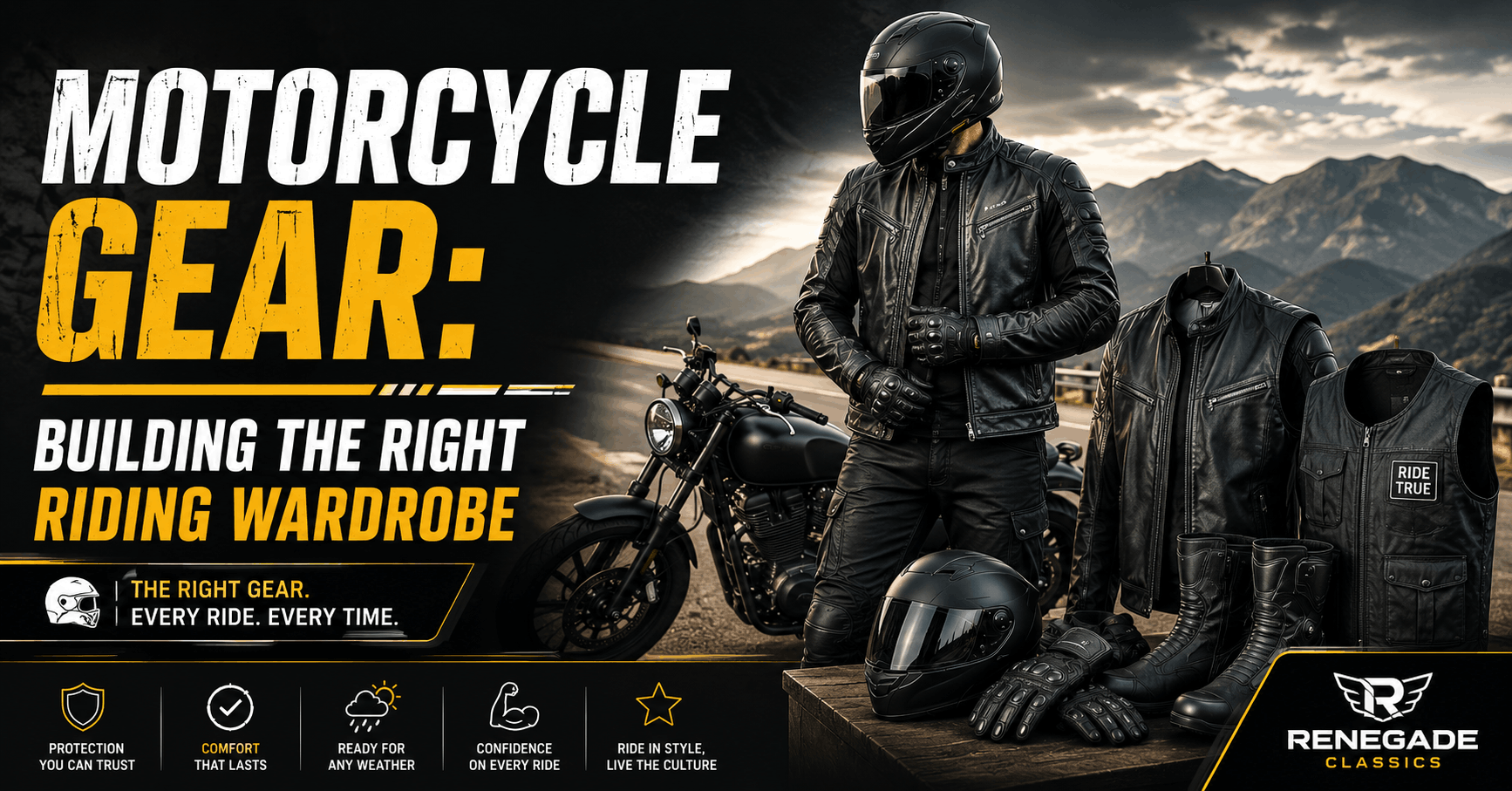
Motorcycle gear is a safety system, not a fashion category. A rider’s wardrobe is expected to provide abrasion resistance, impact protection, weather management, visibility, and ergonomic comfort while remaining practical for everyday use. Building the right riding wardrobe means selecting gear that matches the motorcycle type, riding environment, climate, and trip duration rather than buying isolated pieces based on appearance alone.


Industry safety frameworks generally divide protective gear into several layers: a certified helmet, impact-rated garments with armor, abrasion-resistant outer materials, gloves, boots, and weather-specific layers. Leather remains one of the most widely used abrasion-resistant materials for cruiser and heritage-oriented riding, which is why Men's Leather Jackets and Men's Leather Vests continue to be common components of many riders’ wardrobes.
This article explains how professionals approach gear selection, how leather jackets and vests fit into a complete system, what standards matter, and which mistakes frequently reduce real-world protection.
The Purpose of a Riding Wardrobe
Protective clothing serves multiple functions simultaneously:
|
Function |
What it does |
Why it matters |
|---|---|---|
|
Impact protection |
Armor absorbs and distributes crash energy. |
Reduces injury severity at common strike zones. |
|
Abrasion resistance |
Outer materials resist tearing and road friction. |
Protects skin during a slide. |
|
Weather management |
Controls wind, rain, and temperature. |
Reduces fatigue and maintains concentration. |
|
Visibility |
Uses contrast colors, reflective elements, and lighting-friendly surfaces. |
Improves conspicuity in traffic. |
|
Ergonomics |
Accommodates riding posture and movement. |
Prevents distraction and pressure points. |
Experienced riders often organize gear by riding scenario rather than by garment category: commuting, touring, weekend cruiser riding, hot-weather riding, and cold-weather riding each place different demands on the system.
The Core Protective Layers
Helmet: The Foundation
A helmet is the primary head-protection component. In the United States, street helmets are commonly selected with DOT FMVSS 218 certification as the minimum legal benchmark where applicable. Many riders also consider ECE 22.06 because it includes more comprehensive impact and rotational-testing protocols than earlier standards.
Practical benchmark
Choose a helmet that fits the rider’s head shape correctly, secures firmly without pressure hotspots, and carries a recognized certification. A premium standard does not compensate for poor fit.
Jacket: Abrasion + Armor + Weather Control
A motorcycle jacket typically carries armor at the shoulders and elbows and may include a back protector or a pocket for one. Material choices include leather, textile, and laminated waterproof constructions.
For cruiser, touring, and heritage-oriented riding, Men's Leather Jackets are frequently chosen because quality motorcycle-grade leather provides substantial abrasion resistance and wind blocking. Professional fitters generally look for:
-
Pre-curved sleeves that match the riding posture.
-
Armor positioned correctly over the shoulder and elbow when seated on the motorcycle.
-
Sufficient room for a base layer without excessive looseness that allows armor migration.
-
Secure cuff and waist closures to limit wind inflation at highway speeds.
-
YKK-type heavy-duty zippers or equivalent hardware designed for repeated stress.
Leather thickness, seam construction, and panel layout matter more than fashion styling. Motorcycle-specific jackets are built differently from casual leather jackets, with reinforced seams, abrasion-oriented hides, and armor integration.
Vest: Supplemental Coverage and Layering Tool

Men's Leather Vests occupy a more specialized role. A vest adds torso abrasion coverage, storage capacity, club-patch placement space, and wind blocking over the chest, but it does not replace a protective jacket because it leaves the shoulders and arms exposed.
In practice, vests are commonly used in three ways:
|
Use case |
How it is applied |
Protection implication |
|---|---|---|
|
Over an armored shirt |
Vest adds abrasion coverage and storage while the armored shirt supplies impact protection. |
Protection depends heavily on the armored shirt’s certification and coverage. |
|
Over a jacket |
Vest adds utility pockets, club identification, or extra wind blocking. |
Jacket remains the primary protective garment. |
|
As a standalone garment |
Common in very hot weather or casual cruising. |
Provides limited torso abrasion coverage and no arm protection; experts generally view this as a significant protection compromise. |
When evaluating a vest, professionals look for motorcycle-specific features such as durable leather, reinforced seams, secure closures, accessible pockets while seated, and a fit that does not bunch under a jacket or flap excessively at speed.
Gloves: Often Undervalued, Frequently Injured
Hands are commonly involved in crash dynamics. Effective motorcycle gloves generally include:
-
Full-finger coverage.
-
Palm reinforcement (often leather or synthetic suede overlays).
-
Knuckle and finger protection.
-
Secure wrist retention to prevent glove ejection.
-
Touchscreen compatibility only as a secondary convenience feature.
Fit is critical: gloves that are too tight reduce dexterity, while oversized gloves can shift during impact.
Boots: Ankle Protection Matters
Motorcycle boots differ from fashion boots by providing ankle stabilization, crush resistance, and oil-resistant soles. Key features include:
-
Over-the-ankle height.
-
Shift-pad reinforcement on the left boot.
-
Stiffened sole with controlled flex.
-
Secure closure system that cannot easily snag controls.
How Professionals Build a Versatile Wardrobe
Rather than buying a single “all-purpose” outfit, experienced riders often create a modular wardrobe.
1. Base Protective Kit
-
Certified helmet
-
Armored motorcycle jacket
-
Full-finger gloves
-
Over-the-ankle motorcycle boots
-
Protective riding pants or jeans with armor
2. Seasonal Layers
|
Condition |
Common additions |
|---|---|
|
Hot weather |
Mesh or highly ventilated armored jacket, moisture-wicking base layer. |
|
Cool weather |
Thermal mid-layer, wind-blocking neck gaiter, insulated gloves. |
|
Wet weather |
Waterproof outer shell or laminated jacket, waterproof gloves and boots. |
|
Touring variability |
Packable rain layer, spare gloves, and layering system rather than one heavy garment. |
3. Cruiser/Heritage Additions
-
Leather jacket for primary abrasion and wind protection.
-
Leather vest for utility, layering, and club/patch use.
-
Rain shell that fits over leather when weather changes unexpectedly.
Armor Standards and What They Mean
Protective armor is commonly tested under European standards such as EN 1621-1 (limb armor) and EN 1621-2 (back protectors). Armor is typically rated Level 1 or Level 2, with Level 2 transmitting less force in laboratory testing.
Best-practice reading of armor labels
-
Verify the armor standard and level.
-
Check coverage area, not just certification.
-
Ensure the armor sits in the correct location when riding.
-
Replace damaged, compressed, or aged armor according to manufacturer guidance.
A highly protective armor insert provides limited benefit if it rotates away from the impact zone due to poor garment fit.
Fit: The Most Overlooked Safety Variable
Retail fit sessions often reveal that riders prioritize comfort while standing, even though gear is used primarily while seated. Professionals therefore assess fit on the motorcycle or in a riding posture.
Key checks include:
|
Garment |
Fit check |
|---|---|
|
Jacket |
Armor remains centered when arms reach the bars; sleeves do not ride excessively up the forearm. |
|
Vest |
Does not bunch at the abdomen while seated; closures remain comfortable at breathing expansion. |
|
Gloves |
Fingertips reach the end without pressure; wrist closure secures firmly. |
|
Boots |
Ankle is stabilized; shifting and braking remain precise. |
|
Pants |
Knee armor stays over the patella when seated; cuffs maintain coverage. |
Excessively loose gear can allow armor migration and seam stress, while overly tight gear can restrict movement and reduce control inputs.
Common Mistakes and Misconceptions
|
Misconception |
Why it is problematic |
|---|---|
|
“A leather vest is enough protection for street riding.” |
A vest leaves shoulders, elbows, and forearms unprotected and usually contains no impact armor. |
|
“Any leather jacket is a motorcycle jacket.” |
Fashion leather jackets may lack abrasion-focused construction, reinforced seams, and armor integration. |
|
“Bigger gear is safer because it is more comfortable.” |
Oversized garments can allow armor movement and material bunching during a crash. |
|
“Mesh gear is always less protective.” |
Protection depends on certification, materials, and construction; some modern mesh garments meet recognized abrasion and impact standards. |
|
“Waterproof liners make leather maintenance unnecessary.” |
Leather still requires cleaning, conditioning, and proper drying practices to maintain durability. |
Expert Best Practices
-
Build around protection, then optimize comfort: Start with a certified helmet, armored jacket, gloves, boots, and protective pants; add leather vests and accessories only after core coverage is addressed.
-
Choose motorcycle-specific leather garments: Prioritize armor compatibility, seam reinforcement, hardware quality, and riding ergonomics over casual styling.
-
Use a layering strategy instead of one “four-season” compromise: Separate base, insulating, and weather layers are easier to adapt across climates.
-
Evaluate fit in riding posture: Sit on the motorcycle or simulate the posture before finalizing size.
-
Maintain gear proactively: Clean leather appropriately, inspect seams and zippers, replace crash-damaged gear, and follow manufacturer care guidance.
Frequently Asked Questions
1. Are leather jackets still considered effective motorcycle protection compared with modern textiles?
Quality motorcycle-specific leather jackets remain highly regarded for abrasion resistance and wind blocking. Modern textiles may offer lighter weight, better ventilation, and easier waterproofing. The better choice depends on climate, riding style, and whether the specific garment carries recognized abrasion and armor certifications.
2. What is the practical role of a leather vest in a riding wardrobe?
A leather vest is best viewed as a supplemental layer. It adds torso abrasion coverage, storage, and wind blocking, and it is commonly worn over an armored shirt or jacket. It is not a substitute for a protective jacket because it does not cover the arms or shoulders and typically lacks impact armor.
3. How should a motorcycle jacket fit?
The jacket should be assessed in riding posture, not only while standing. Armor must remain centered over the shoulders and elbows with hands on the bars, sleeves should maintain wrist coverage, and the torso should be snug enough to limit armor migration while still allowing comfortable movement and layering.
4. Is thicker leather always safer?
Not necessarily. Protection depends on hide quality, tanning, seam construction, panel layout, armor integration, and certification where applicable. Excessively thick leather can reduce mobility and comfort, which may discourage consistent use. Motorcycle-specific construction is generally more important than thickness alone.
5. What armor ratings should riders look for?
For limb armor, EN 1621-1 is the commonly referenced standard; for back protectors, EN 1621-2. Level 2 armor transmits less force in laboratory testing than Level 1, but correct fit and coverage are just as important as the rating itself.
6. Can a vest be worn over an armored shirt instead of a jacket?
Many riders use that configuration, especially in warm weather. The armored shirt provides impact protection, while the vest adds abrasion coverage and utility. Overall protection varies significantly by the armored shirt’s certification, abrasion rating, and coverage.
7. How often should motorcycle gear be replaced?
Replace any gear that has experienced a significant crash, has damaged seams or hardware, shows compromised armor, or no longer fits correctly. Helmet replacement intervals should follow the manufacturer’s guidance and any damage-related recommendations.
8. Why do experienced riders own multiple jackets?
No single jacket performs optimally in all conditions. Riders commonly maintain a ventilated hot-weather jacket, a cooler-weather or leather jacket, and a waterproof touring option, then combine them with appropriate base and mid-layers.
9. Are motorcycle jeans adequate for everyday riding?
Protective riding jeans can be appropriate if they are motorcycle-specific, use abrasion-resistant materials, and include correctly positioned armor. Ordinary fashion denim should not be assumed to provide equivalent protection.
10. What is the single most important upgrade for a new rider’s wardrobe?
After obtaining a properly fitted certified helmet, the most consequential upgrade is usually a motorcycle-specific armored jacket that fits correctly in riding posture, because it combines abrasion resistance, impact protection, and weather management in one core garment.
Conclusion
Building the right motorcycle riding wardrobe is a system-design exercise rather than a style exercise. The most effective approach starts with a properly fitted certified helmet, an armored motorcycle-specific jacket, gloves, boots, and protective pants, then adds climate layers and utility pieces as needed. Men's Leather Jackets remain a practical choice for many cruiser, touring, and heritage riders because they combine strong abrasion resistance with wind protection and armor compatibility. Men's Leather Vests are best treated as supplemental layering and utility garments, not replacements for protective jackets.
Professionals consistently prioritize fit in riding posture, recognized armor standards, motorcycle-specific construction, and a modular layering strategy. Those principles produce a wardrobe that is safer, more adaptable across weather conditions, and more likely to be worn consistently over the long term.

 Arabic
 French
 Spanish
 Portuguese
 Deutsch
 Turkish
 Dutch
Dutch
 Italiano
 Russian
 Romaian
 Portuguese (Brazil)
 Greek
Greek
